8/31/2026
Confidence Says I Can Solve This. Arrogance Decides Nobody Needs to Know.
Trust is not lost when problems arise but when leaders discover them last. Silence that feels like ownership quietly spends credibility that takes years to rebuild.
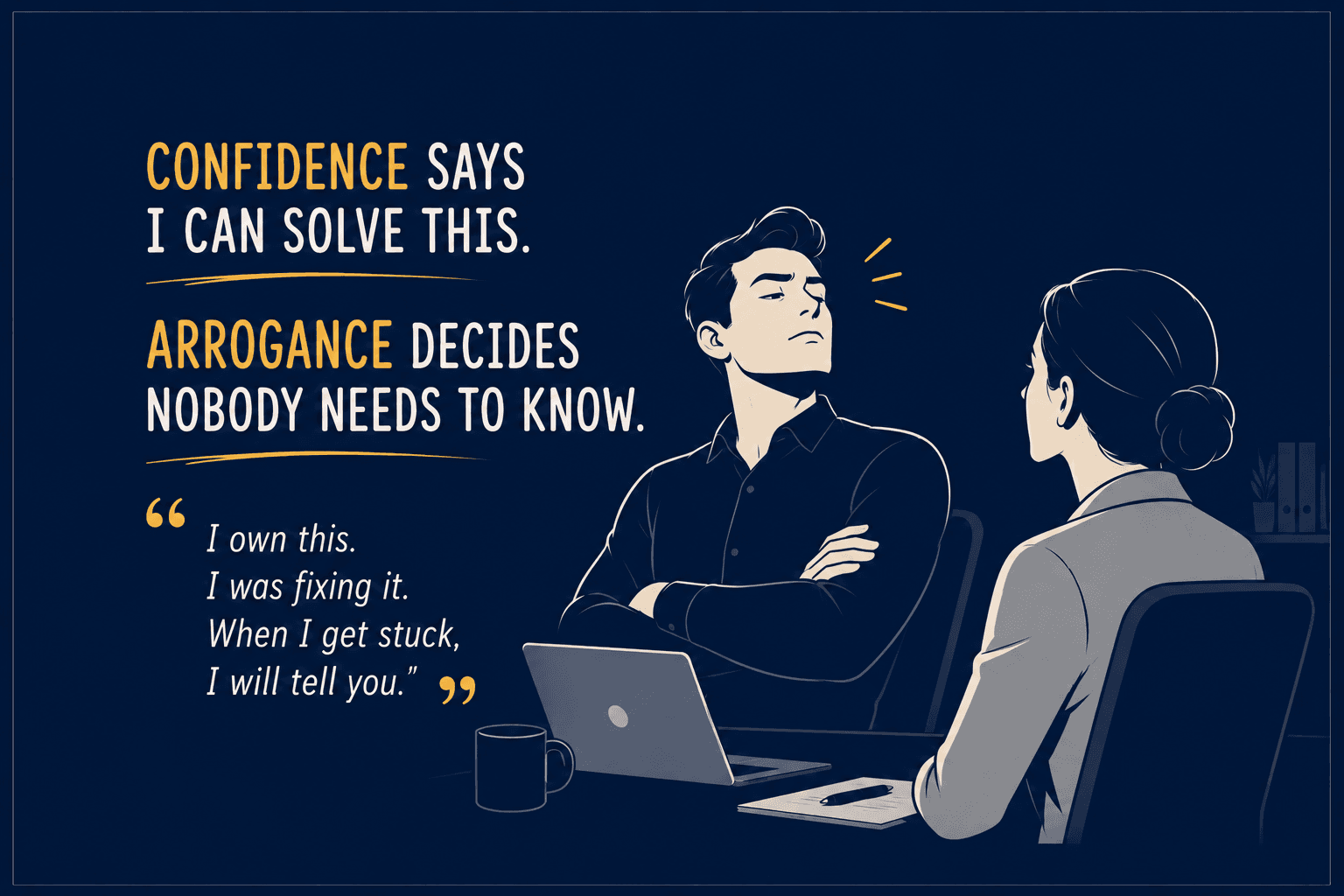
That is what one of my team members said when I sat him down this week.
He was right about one thing. He did own it. The workstream was his, he had been working the problem, and he was confident he could close it. Nothing he said was untrue.
But he missed something. That workstream sits inside a project I lead. And I did not hear about the issue from him. It came back to me through a stakeholder who had been left out of the loop, in a complaint, days after it started.
By the time I knew, there were two problems. The technical one he was solving. And the one created by three people finding out late, including me.
The Hidden Cost of Staying Quiet
Here is the part that matters more than the delay. It was not just information I lost. It was ground.
I had been speaking to that stakeholder with a picture that was no longer true, which means I had unknowingly been telling them something wrong. And once a stakeholder has watched you be wrong about your own project, they start going around you to check.
He thought he was protecting me from noise. What he actually did was quietly spend my credibility to buy himself room.
And it cost him something too. Trust is not built in the moment you deliver. It is built in the moments you choose to tell someone something they would rather not hear. He had a chance to build it and he spent it instead, without ever realising there was a transaction happening.
Key takeaway: Staying quiet to protect your manager from noise does not save them anything. It spends their credibility without their knowledge — and costs you the trust you could have built instead.
Why This Happens to Your Best People
This is almost never a performance problem. It happens to the capable ones. The ones you do not worry about.
Somewhere early on, they learned that competence means handling things. They got praised for being low maintenance. For never needing to be chased. For being the person who just gets it done. So they built an instinct around it, and the instinct is: when something slips, go quiet and go to work.
Raising it before they have an answer feels like the opposite of everything they have been rewarded for. It feels like admitting they cannot handle it. It feels like inviting someone to hover, or worse, to take it away.
So they decide, reasonably in their own mind, to surface it once they have something clean to show. A cause. A fix. A plan with dates. They are not hiding. They genuinely believe they are protecting you.
That is why the conversation is harder than it looks. You are not correcting bad behaviour. You are correcting a habit that has been working for them for fifteen years.
The Line Between Confidence and Arrogance
Confidence is believing you can solve it.
Arrogance is deciding, on everyone else's behalf, that nobody needs to know while you do.
From the inside, those two feel identical. Both feel like ownership. Neither feels like arrogance, because arrogance is something other people have — and they are just heads down doing the work.
From the outside, only one of them is visible.
While they are quietly solving, other people are operating on information that is no longer true. Making commitments on top of theirs. Speaking to clients with the old picture. And when the truth surfaces, it does not surface as a solved problem. It surfaces as a surprise, usually through someone who is annoyed.
That is the moment the story stops being about the problem and starts being about them.
How to Have the Conversation
Start in the right place
Do not open with the delay. If you lead with "you should have told me sooner," they will hear it as a process complaint and give you a process answer — which is exactly what I got.
Start with what they could not see. They own a workstream. You own the surface between that workstream and everyone else. When they hold information, they are not just delaying you — they are making decisions for you about what you say to stakeholders and what you get caught out on.
Name the distinction directly
Tell them you are not questioning whether they can solve it. You are telling them that solving it alone is only half the job. Here is the line I use, because it separates the two things they have fused together in their head:
Try this: "I need to hear it from you first. Not because I do not trust you to fix it, but because we have to show up as one unit, and I cannot back you if I find out after everyone else has."
That works because it removes the thing they are actually defending. They are braced for you to doubt their competence. That sentence explicitly does not. It reframes the update as what makes the two of you a team rather than two people working near each other — and it makes clear that the cost of silence lands on both of you.
Make it concrete
"Communicate more" is not an instruction anyone can follow. Give them the trigger and the format.
- The trigger is not when they are stuck. It is the moment anyone outside the team is operating on a picture that has changed.
- The format is three lines: what I am seeing, what I am doing, when I will come back.
Watch the next one closely
If the update arrives, say so out loud. This habit was built on years of being rewarded for silence. It will only rebuild if the new behaviour gets rewarded faster.
A Question Worth Sitting With
What have you found out about too late — and what did it change about how you saw the person who did not tell you?