9/21/2026
Politics Moves Faster Than Clarity: When Commitments Outrun Execution
Stakeholder alignment and execution clarity are not the same thing, and confusing the two leaves delivery teams chasing context they never received. Politics can secure a commitment, but clarity is what makes it executable.
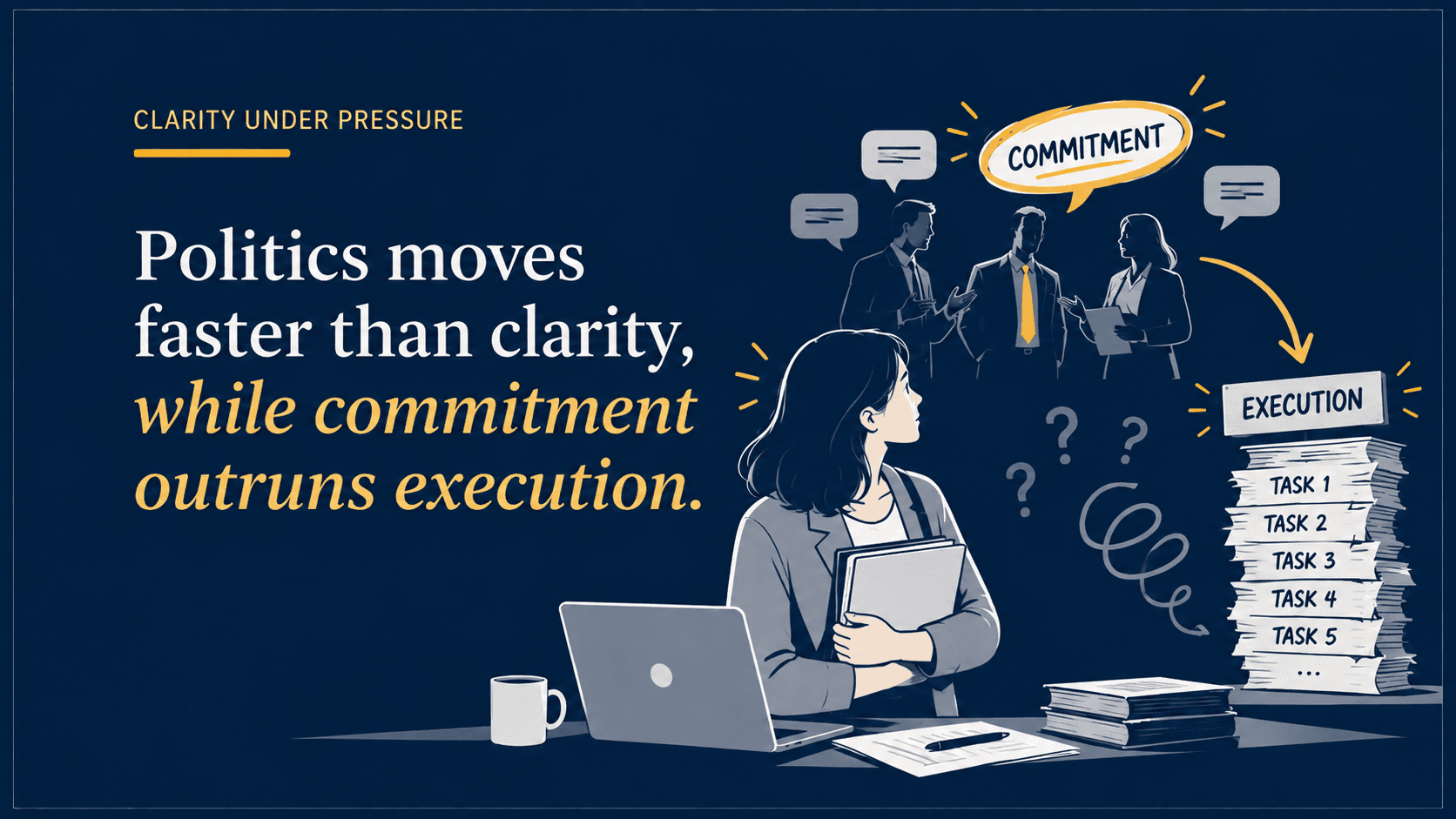
Recently, I've found myself going in circles trying to get enough clarity to move a large initiative forward.
I'd ask questions. Talk to different stakeholders. Piece together the answers. Eventually, I'd feel like I understood what we were executing.
Then something would change.
A piece of information was no longer true. Something I thought was still open had apparently been decided. Or a new commitment would appear that changed what the team was expected to deliver.
And I'd start chasing clarity again.
At first, I thought I simply had an information problem. Then I started noticing something else.
The people executing the work had pieces of the picture. The people managing the relationships had the whole picture. And the whole picture was constantly changing through conversations the execution team wasn't part of.
The Pressure: Commitment Moves Faster Than Clarity
I've seen versions of this throughout my career, especially in large transformations.
A direction changes. Someone close to senior leadership has the conversations, builds support, and gets alignment around the new direction. Then the commitment moves downstream.
"We've agreed to this." "Leadership wants this." "We need to move quickly."
From the top, it looks like progress. The conversations happened. Stakeholders are aligned. A direction has been set.
But the execution team receives the commitment without all the context that created it.
- What exactly was agreed?
- What assumptions were made?
- What is fixed?
- What is still negotiable?
- How does this affect everything already underway?
Those questions surface quickly, because the people doing the work have to turn the agreement into something real.
What's Really Happening
Organizations need people who are good at navigating relationships. They build trust, resolve disagreements, secure sponsorship, understand what different stakeholders need, and get people behind a direction. That matters.
But there's an important distinction: relationship alignment isn't execution clarity.
A successful stakeholder conversation doesn't automatically produce an executable decision.
How the cycle compounds the problem
Execution raises questions because the pieces don't fit. Someone goes back to the stakeholders, has a few conversations, and smooths things over. But those conversations create additional commitments — and those commitments come downstream too.
Now the execution team has more things to deliver, and still doesn't have the whole picture.
The ambiguity hasn't disappeared. It has been transferred to execution.
Key takeaway: When alignment conversations create new commitments without passing along context, ambiguity doesn't go away — it simply gets handed off to the people responsible for delivering the work.
Create Clarity by Reconstructing the Commitment
This is where I've stopped chasing every individual answer. When disconnected asks keep arriving, the more useful move is to step back and reconstruct the commitment itself.
For any meaningful change, get clear on five things
- What changed?
What is different from the direction we were previously working toward? - What was actually agreed?
Not what we think leadership wants — what commitment was actually made? - What is fixed?
Which parts are genuinely decided? - What is still open?
Where does the execution team still have room to shape the answer? - What changes downstream?
What priorities, timelines, dependencies, or existing commitments now need to move?
You don't need a transcript of every stakeholder conversation. You need a reliable handoff between two different kinds of work: relationship alignment → execution clarity.
If the big picture exists primarily in someone's conversations, everyone else becomes dependent on that person to interpret what is actually true. And when another conversation happens, yesterday's clarity can suddenly become outdated.
Politics and Clarity Aren't Opposites
Complex work needs people who can build relationships, negotiate differences, and create alignment. It also needs people who can turn that alignment into something executable.
The problem comes when we confuse the two.
"I handled the relationship" is not the same as "the team has what it needs to execute."
A commitment made upstream has to arrive downstream with enough context to become a decision, a priority, and eventually a plan. Otherwise, everyone can leave a stakeholder conversation feeling aligned while the people responsible for delivering the work are still trying to figure out what everyone agreed to.
Key takeaway: Politics can get the commitment made. Clarity makes the commitment executable.