8/3/2026
Product Owner & Project Manager - In AI Transformation, These Roles Are Becoming One.
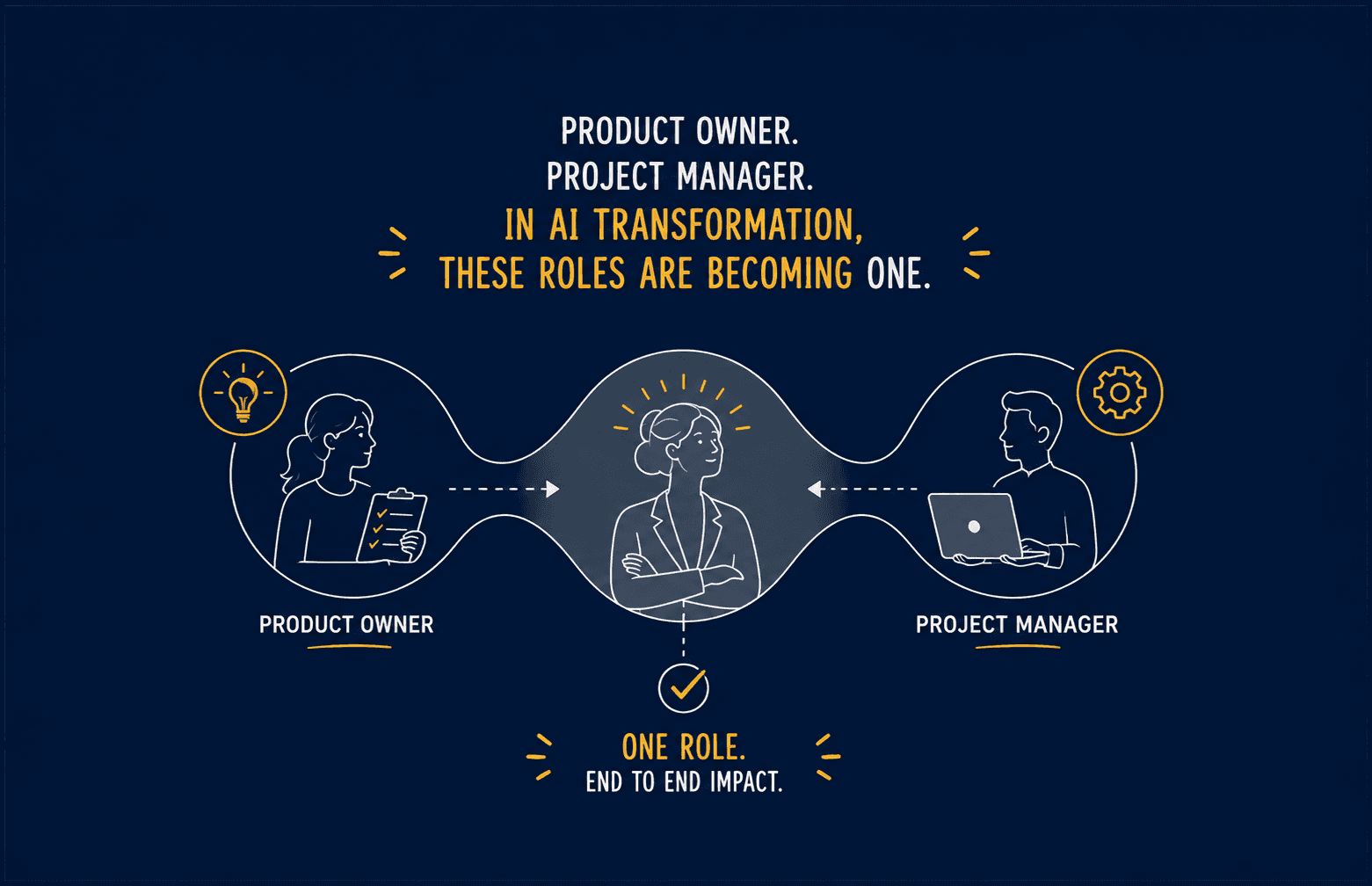
Across AI transformation programs, the traditional product owner and project manager roles are colliding — and the most effective programs are forcing them to merge.
Most of the pressure moments I write about are evergreen. They show up whenever people collaborate, whenever stakes are high, whenever visibility and ownership are in play. The dynamics change, but the moments themselves are timeless.
But some pressure moments are not timeless. They are shaped by the environment we are operating in right now — emerging in real time, created by the speed of change, the nature of the work, and the way organizations are restructuring around new priorities.
This is one of those moments.
What I Keep Seeing Across Programs
In the last few years I have been leading AI and data transformation programs across multiple large organizations in different industries. Flagship programs. High stakes. High visibility. The kind of initiatives that sit at the top of the executive agenda and carry the weight of an entire organization's digital future.
And across all of them — different companies, different industries, different teams — I keep observing the same thing.
Two roles that used to sit in separate lanes are being asked to do the same job from opposite directions. And most organizations have not named it yet.
The Old Way: Three Roles, Three Lanes
The model was clean in theory.
- The product manager owned the vision — the what and the why. Business strategy, roadmap, stakeholder alignment at the executive level.
- The product owner owned the bridge — backlog, user stories, sprint ceremonies. Translating strategy into work the development team could execute week by week.
- The project manager owned delivery — timelines, dependencies, risk, coordination. Making sure the work got done on time and within scope.
Three roles. Three lanes. Clean handoffs. A model built for a world where the blueprint existed before the program started.
What AI Transformation Programs Actually Look Like
The blueprint does not exist.
These are not traditional programs with defined scope and established process. They are flagship initiatives where the team is building the methodology as they go — fast iterative testing, constant direction switching, requests nobody anticipated surfacing mid-program, escalations happening before anyone has defined who owns what.
The Numbers Behind the Shift
- Global demand for project management talent is projected to rise 64% from 2025 to 2035, yet supply could fall short by nearly 30 million professionals.
- The demand is not for the traditional project manager. Data and AI fluency are now described as core competencies for all delivery professionals.
- 67% of organizations struggle with role clarity between product managers and project managers, leading to misaligned priorities, duplicated efforts, and ultimately failed product launches.
Where the Gaps Show Up
In AI transformation programs, the old three-lane model starts to break down in visible ways. A dependency falls through because the product owner thought the project manager owned it — and the project manager thought the product owner owned it.
A senior stakeholder asks for a status update and gets three different answers from three different roles. The gap between lanes becomes visible at exactly the moments when these programs need the most clarity and speed.
Key takeaway: The role confusion is not a personnel problem. It is a structural one — built into a model that was never designed for programs where the methodology is being invented in real time.
My Point of View
The product manager stays where they belong — at the business level, holding strategy and roadmap.
But the product owner and project manager are colliding. And in the most effective programs I have led, they are beginning to merge. Not because of a structural decision, but because the environment is forcing it.
This is not about job descriptions. It is about capability and mindset.
The professional who will lead these programs effectively holds both — product lifecycle thinking and delivery discipline simultaneously — owning the full value stream from business requirement to technology delivery without dropping either end.
What This Means If You Are in One of These Roles
That merged role does not have a clean title yet. But it is already showing up in every transformation program I have been part of.
If you are currently in one of these roles and moving into a program like this, start thinking about how to prepare. Not by changing your title. By expanding what you can hold.
Try this: Map your current responsibilities against both the product owner and project manager lanes. Where are the gaps? Where are the overlaps? That intersection is where the real work of these programs lives — and where you need to be ready to operate.
Until next time.
— Ivy