8/17/2026
The Hamster Wheel Problem in AI Transformation — And How to Get Off It.
Ivy reflects on the hidden cost of speed in AI transformation programs, where reactive, one-off responses create compounding technical debt that only becomes visible once the program ends.
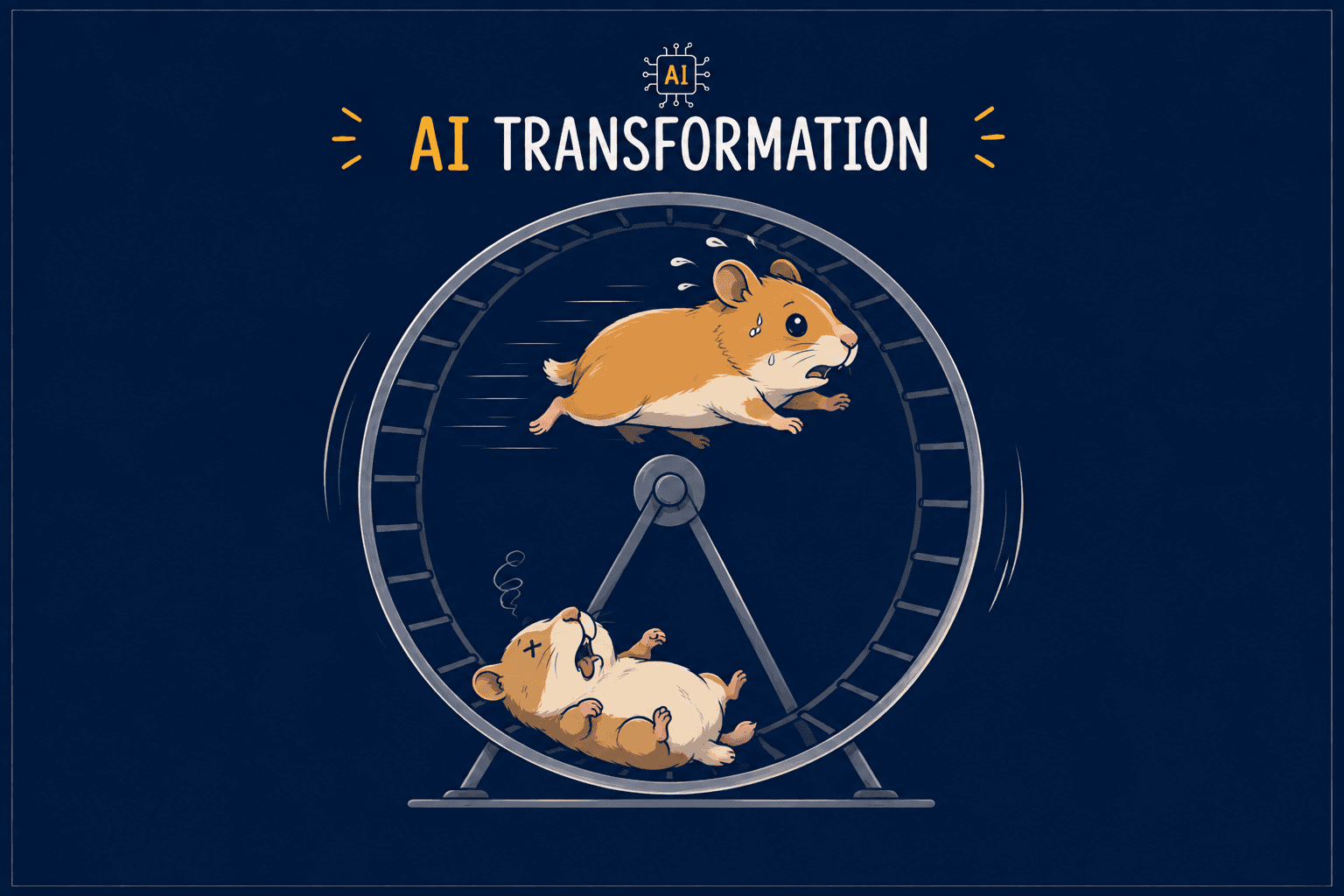
Taking a moment to reflect on the past few weeks.
The best way I can describe it: a hamster on a wheel.
If you have been following along, you know my story in this AI transformation initiative continues. And this week brought a new pressure moment — one I think will be familiar to anyone leading programs like this.
The Nature of AI Transformation Programs
AI transformation programs are designed for speed. That is their nature. Things move fast. Requests come in constantly. So you respond. You allocate. You break down the work and keep moving.
And most of it — when I stopped to look honestly — was a one-time thing. Built for that specific request, that specific moment, that specific workstream. Not reusable. Not applicable anywhere else. Just a response that closed a ticket and left nothing behind.
Then I remembered something I have witnessed in previous programs. The realization does not come during the initiative. It comes in the aftermath. Massive teams brought in after the fact to fix what was built too fast. The cleanup bill arrives long after the people who built it fast have moved on.
So I called a meeting. One thing I raised clearly: we are constantly chasing moving targets — requests coming in ad hoc, reactive mode all day. We cannot be successful this way. What is the real urgency behind each of these asks?
That question changed how we do things from that moment forward.
Why Moving Fast Has a Hidden Cost
Speed is the expectation in AI transformation. But speed without structure quietly builds a debt that compounds until it cannot be ignored.
Key takeaway: 75% of technology decision-makers expect technical debt to reach a severe level in 2026 — and AI adoption is a primary driver. Companies that ignored this saw returns on AI projects drop by 18% to 29%, with timelines expanding by as much as 22%.
The dangerous thing about this kind of debt is that it is invisible while it is building. Every one-off response feels like progress. Every ticket closed feels like momentum. But underneath, the foundation is getting more fragile with every shortcut. And when the program ends and the next team inherits it — or when the business tries to scale what was built — the cost becomes visible all at once.
I have watched this happen more than once. It is not a cautionary tale. It is a pattern.
The traditional ways of doing things — defined scope, sequential delivery, structured process — no longer match the speed these programs demand. But the answer is not to abandon structure. It is to build structure that moves at the speed of the program. Lean. Reusable. Scalable from the very first response.
Three Moves to Get Off the Wheel
The shift starts with a single question asked consistently before reacting to every new request:
Is this a one-off — or is this a pattern that will come up again across other workstreams or future programs?
If it is a one-off, address it and close it. If it is a pattern, build for the pattern.
One — Pause before you react
Take thirty seconds before assigning the next request. Ask the question. If it is a pattern, build the process around the response, not just the response itself. The extra time spent doing this right is not overhead. It is the investment that accelerates everything that follows.
Two — Build every response from a solid foundation
Do not start from zero if you do not have to. Every time a new ask arrives, ask what already exists that this can build from — a template, a framework, a decision process from a previous workstream. Over time this compounds. The program that was reactive in week one is operating from a reusable foundation by week eight.
Three — Leverage AI tools to systematize faster
AI is not just the thing you are transforming toward. It is the tool that helps you build the transformation in a way that scales. Use it to capture process decisions in real time. Turn the lessons being learned inside the program into reusable assets the next program can start from.
Key takeaway: The hamster wheel feels like progress. It is not. The goal is to get off it before the program ends and the bill arrives.
Deliver with clarity. Be seen with integrity.
— Ivy