10/12/2026
When Ownership Changes, Decisions Stall: The Cost of Unclear Accountability
When responsibility changes hands in organizational transitions, decisions often stall because clarity about authority and context hasn't fully transferred alongside ownership.
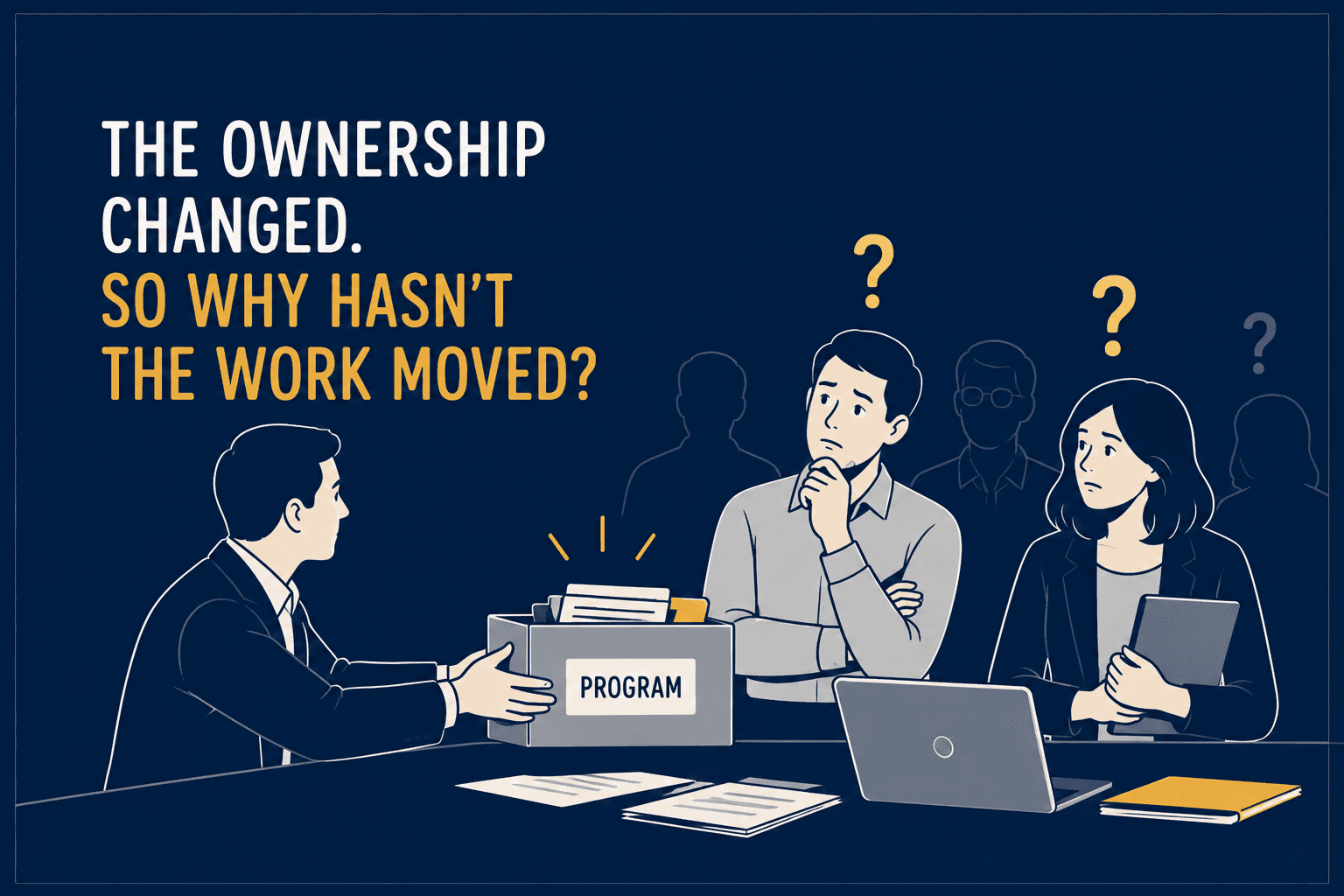
When Responsibility Changes Hands
When responsibility changes hands, decisions can get stuck in the middle.
"Has the initiative moved forward?"
"No, I don't think so."
"Who's responsible for driving it?"
"I'm not sure."
"Has the decision been communicated?"
"No."
"Who's supposed to make that decision?"
"Not sure."
"Okay. We need a meeting."
This was essentially a conversation I had last week.
A program was transitioning to new ownership. More stakeholders were becoming involved, responsibilities were shifting, and teams were trying to establish how the work would operate going forward.
The previous owners had handed things over. The new owners were still getting up to speed. And somewhere in between, an important decision had stopped moving.
Not because people necessarily lacked initiative or commitment — but because responsibility had changed hands before the clarity needed to act on it had fully transferred.
The Gap Between Ownership and Readiness
I've seen this pattern across complex programs and organizational transitions.
On paper, the handoff is complete. Responsibilities have been reassigned. New leaders have stepped in. Everyone understands that ownership has changed.
But the new owner may not yet have the full context, relationships, or clarity about decision authority needed to move confidently. Meanwhile, the previous owner has stepped back. And the work still needs to move.
Two Common Responses
When that gap opens up, teams tend to respond in one of two ways.
Some people take initiative. They make reasonable assumptions and start driving things forward. That initiative is valuable — but without shared direction, teams can move quickly toward different outcomes, creating rework later.
Others wait. They need a decision, an approval, or confirmation of priorities before they can responsibly proceed. So the work sits. Dependencies remain unresolved. Time passes.
Neither response is necessarily wrong. Both can be symptoms of the same underlying problem: the organization hasn't made it clear how decisions will move under the new ownership.
More Meetings or Fewer Meetings?
This is where governance becomes important — and where another familiar tension tends to surface.
"Too many meetings. Too many people."
It's fair feedback. As more stakeholders become involved, the natural response is often to create additional forums to keep everyone informed and aligned. But I've learned to separate three distinct needs:
- Decision-making: Who has the authority to decide? Where do unresolved trade-offs go?
- Execution alignment: How do teams coordinate dependencies, clarify accountability, and agree on next steps?
- Communication: How do decisions reach everyone whose work depends on them?
These are different purposes. They don't necessarily require the same participants, the same frequency, or even a meeting.
Not everyone who needs to know about a decision needs to attend the meeting where it's made.
But eliminating a meeting without establishing another reliable way to share decisions doesn't eliminate the coordination cost. It often moves that cost into follow-ups, conflicting assumptions, rework, and delays.
Key takeaway: The question isn't whether to have meetings — it's whether you have a reliable path from a decision that needs to be made to action that can follow.
Start With the Decision That's Stuck
When work slows during a transition, I find it useful to start with four questions:
- What specific decision is holding up progress?
- Who has the authority to make it now?
- What context or input does that person need?
- Who needs to know the outcome to move forward?
Sometimes the issue is unclear accountability. Sometimes the new owner needs context that still sits with the previous team. Sometimes the decision has already been made but hasn't reached the people doing the work.
And sometimes a meeting really is needed.
The point isn't to defend meetings or eliminate them — it's to establish a reliable path from a decision that needs to be made to action that can follow.
The Real Measure of a Successful Handoff
Ownership transitions will always involve some uncertainty. New leaders need time to understand the work. Relationships evolve. Ways of working change.
But the team shouldn't have to wait for every piece of the transition to settle before meaningful progress can continue.
A successful handoff isn't simply about transferring responsibility. It's about transferring the context, authority, and alignment needed to act on that responsibility.
Key takeaway: When ownership changes, clarity has to move with it. Otherwise, the handoff may be complete on paper while the work remains on hold.
Don't wait for clarity. Create it.